
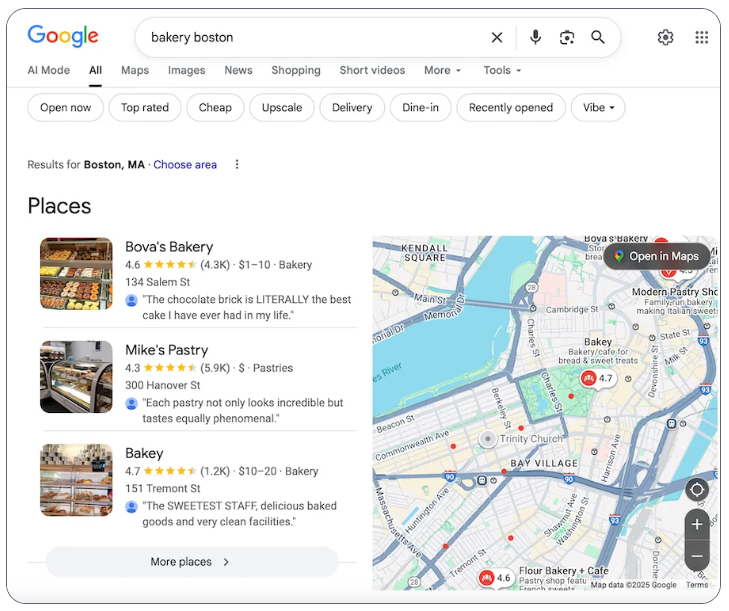
Understanding the right Google Maps ranking factors — and acting on them — is the difference between showing up in the Local 3-Pack and being invisible.
What’s in This Guide
How To Get Ranked On Google Maps
Many business owners search for guidance on how to get ranked on Google Maps, and Moz’s local SEO research shows that relevance, proximity, and prominence all play a role in visibility.
How to Improve Your Google Maps Rankings Factors: A Step-by-Step Guide
If your business isn’t showing up in the Google Maps results for your city, you’re missing the leads that matter most: people who are nearby, actively searching, and ready to act. This guide breaks down exactly how Google decides which businesses to rank in Maps — and, more importantly, what you can do right now to move up.
Understanding Google’s Three Ranking Pillars
Google uses three core signals to rank every business in Maps. You can’t fully control all three — but understanding them changes how you prioritize your effort.
Proximity. How close your physical address is to where the searcher is located (or the city they typed in). This is hard to manipulate, but accurate NAP information and a correctly placed map pin both help.
Relevance. How well your listing and website match what the user searched for. Driven by your GBP categories, keywords in your content, and user-generated signals like reviews. Highly actionable.
Prominence. How well-known and trusted Google perceives your business to be. Driven by reviews, backlinks, citations, and how often your business is mentioned across the web. Builds over time — start now.
Real-world note on proximity: If you’re a service-area business with no public storefront, you have less control over this pillar because your address isn’t displayed. Focus extra energy on Relevance and Prominence — that’s where you win the race.
What the 2026 Data Says: Ranking Factor Weights
Each year, Whitespark surveys around 50 local SEO experts on which factors most influence rankings. Here’s how the top categories break down for the Local Pack / Maps in the 2026 study:
|
Category |
Local Pack Weight |
|
Google Business Profile |
32% |
|
Reviews |
20% |
|
On-page signals |
15% |
|
Behavioral signals |
9% |
|
Links / backlinks |
8% |
|
Citations |
6% |
|
Personalization |
6% |
|
Social signals |
4% |
Key data point: Reviews grew from 16% in 2023 to 20% in 2026 — the biggest upward shift of any factor. If you’ve been putting off a review strategy, that window is closing.
Top 15 Specific Local Pack Ranking Factors (2026)
|
Rank |
Factor |
|
1 |
Primary GBP category |
|
2 |
Proximity of address to the point of search |
|
3 |
Keywords in GBP business title |
|
4 |
Physical address in the city of search |
|
5 |
Business is open at the time of search |
|
6 |
High Google star ratings |
|
7 |
Address shows on GBP (not hidden) |
|
8 |
Additional GBP categories |
|
9 |
Number of native Google reviews with text |
|
10 |
Map pin properly placed |
|
11 |
Recency of reviews |
|
12 |
Proximity of address to city center |
|
13 |
Click-through rate from local search results |
|
14 |
Steady growth of reviews over time |
|
15 |
HTML NAP matching GBP NAP |
Source: Whitespark Local Search Ranking Factors Survey, 2026
Step 1 — Claim and Fully Complete Your Google Business Profile
Pillar: Relevance & Prominence | Impact: Very High
Your Google Business Profile (GBP) is the single most influential thing in your Maps ranking — accounting for 32% of Local Pack ranking weight. An unclaimed or half-filled profile is like having a storefront with the lights off.
How to do it:
- Search for your business on google.com/maps. If it exists, look for “Claim this business” and complete the verification process.
- Fill in every single field: name, address, phone, website, hours, special hours, description, and services.
- Use a local area code phone number — toll-free numbers are associated with spam and can suppress your ranking.
- Make sure your hours are accurate and updated for holidays. Google shows “hours might differ” warnings, which hurt click-through rates.
- Check that your map pin is placed correctly on your actual location — this is ranking factor #10 and is a fast fix.
Quick win: Write a business description that clearly states your services and your city or area. Don’t make it a sales pitch — Google reads it to understand what you do and where. Include your primary service keyword and location naturally.
Step 2 — Choose Your Primary and Additional Categories Carefully
Pillar: Relevance | Impact: Very High — the #1 ranked factor
Your primary GBP category is the single highest-weighted ranking factor in the entire Local Pack, per the 2026 Whitespark survey. Getting this wrong — or being too generic — can suppress your visibility for every relevant search.
How to do it:
- Choose a primary category that matches your core service offering, not your industry broadly. “Plumber” beats “Home Services.” “Personal Injury Attorney” beats “Lawyer.”
- Add up to 4 additional categories for secondary services. BrightLocal research found that businesses using four additional categories have the highest average map ranking.
- You cannot create custom categories — search within Google’s dropdown and choose the closest match.
- Never keyword-stuff your business name with words that aren’t in your legal name. This is a guideline violation that risks suspension.
What NOT to do: Selecting broad or incorrect categories is a verified negative ranking signal. “Incorrect Primary Category” is explicitly listed as a factor with a negative impact on rankings in the 2026 survey.
Step 3 — Build and Manage Your Reviews Strategically
Pillar: Prominence | Impact: High — 20% of Local Pack weight
Reviews are now the second most important category in Local Pack rankings, up from 16% in 2023. Google looks at your star rating (factor #6), number of reviews with text (factor #9), recency (factor #11), and steady growth over time (factor #14). That’s four of the top 15 factors coming from reviews alone.
How to do it:
- Ask for reviews actively. After every job or interaction, send a follow-up email or text with a direct link to your Google review page.
- Make it frictionless. Generate your Google review link (search your business in Maps → Share → Copy link), shorten it, and put it in your email signature, invoices, and follow-up messages.
- Respond to every review — positive and negative. Google and consumers both take note.
- Aim for consistency, not volume spikes. Steady review growth over time (factor #14) matters more than getting 20 reviews in one week and then nothing for months.
The language customers use in their reviews helps Google understand what your business does and where — reinforcing both relevance and prominence simultaneously. A review that says “Best plumber in South Philly” does more ranking work than a 5-star with no text.
Step 4 — Optimize Your Website for Local Search
Pillar: Relevance | Impact: High — #1 factor for local organic rankings
Your website and your Maps listing are connected in Google’s eyes. On-page signals account for 33% of local organic ranking weight and directly influence your Maps performance.
Your business Name, Address, and Phone number on your website must exactly match what’s on your GBP — down to abbreviations (“St” vs “Street”). This is factor #15 in the Local Pack list. Put your NAP in your site footer and on your Contact page.
Dedicated service pages
The #1 local organic ranking factor is having a dedicated page for each service. Don’t lump five services onto one page. Each service you offer should have its own page targeting that service plus your city.
Geographic keyword relevance
Weave your city and neighborhood into your page titles, H1 headings, body copy, and image alt text naturally. “We’ve been serving homeowners in Philadelphia’s Fishtown and Kensington neighborhoods since 2012” works far better than repeating the city name robotically.
Technical checklist:
- Mobile-responsive design (60%+ of local searches happen on phones)
- Page load speed under 3 seconds
- LocalBusiness schema markup on your contact or about page
- Google Map embedded on your contact page (helps confirm your location)
- Internal links between your service pages and location pages
Step 5 — Build Citations and Lock In NAP Consistency
Pillar: Prominence | Impact: Medium — growing importance for AI search
A citation is any online mention of your business’s Name, Address, and Phone number — whether or not it links to your site. Yelp, Yellow Pages, the BBB, your local Chamber of Commerce, industry directories: these all count.
How to do it:
- Start with the top-tier national directories: Google Business Profile, Yelp, Bing Places, Apple Maps, Facebook, Yellow Pages, BBB, Foursquare, and Angi (if applicable).
- Then target industry-specific directories relevant to your niche (Houzz for home services, Avvo for lawyers, Healthgrades for healthcare, etc.).
- Audit existing citations for inconsistencies — even small differences in how your address is formatted can confuse Google and suppress your ranking.
- Businesses with consistent NAP data across major citation sources are 40% more likely to appear in the Local 3-Pack, per BrightLocal research.
AI search note: According to the 2026 Local Search Ranking Factors survey, citations are the third most important factor (13%) for AI search visibility. With AI-powered search results growing rapidly, consistent citations are becoming more valuable, not less.
Step 6 — Earn Local Backlinks
Pillar: Prominence | Impact: Medium — 8% of Local Pack weight
Backlinks from other trusted websites signal to Google that your business is authoritative and established in your community. In local SEO, relevance often matters more than raw domain authority — a link from your local newspaper or Chamber of Commerce can outperform a link from a high-DA site with no local connection.
Where to focus for local links:
- Your local Chamber of Commerce membership directory
- Sponsoring local events, charities, or sports teams (they almost always link back)
- Local press coverage — a story in your city’s paper is worth far more than a generic directory
- Guest posts on local business blogs or neighborhood publications
- Partner businesses that you refer work to — ask for a mutual link
- Industry associations with member directories
Step 7 — Post, Engage, and Stay Active on Your GBP
Pillar: Relevance & Prominence | Impact: Indirect — signals active management
Posting and engaging with your GBP doesn’t directly move the ranking needle on its own — the 2026 survey found that the quantity of posts has little ranking impact. But it signals that you’re an active, managed business, which matters for behavioral signals like click-through rate (factor #13) and overall conversions.
What to do:
- Post updates, offers, or seasonal announcements at least once or twice a month
- Add new photos regularly — businesses with photos get significantly more direction requests and website clicks
- Answer questions in the Q&A section before customers have to ask them (and before strangers answer incorrectly)
- Keep your hours accurate at all times — especially for holidays
- Remove any duplicate listings — multiple listings for one business dilute your authority and can trigger a ranking penalty
The AI Search Factor: Why Your Citations Are More Important Than Ever
New in 2026
The 2026 Local Search Ranking Factors survey tracked AI search visibility for the first time. The results show that on-page signals, reviews, citations, and links — the same fundamentals of local SEO — are also the top drivers of visibility in AI-powered search results like Google’s AI Overviews.
Two factors worth highlighting specifically for AI visibility:
- Presence on expert-curated “Best Of” lists — the #1 AI visibility factor. Getting your business onto local listicles and “best [service] in [city]” style pages on third-party sites is becoming critical.
- Unstructured citations — brand mentions on blogs, news sites, and social media without a direct link now drive 13% of AI visibility weight. Be mentioned. Be discussed. Be recommended.
Your Google Maps Ranking Checklist
Use this to audit your current status and track progress.
Google Business Profile
- [ ] GBP is claimed and verified
- [ ] Every field is filled in completely
- [ ] Primary category is the most specific fit for your core service
- [ ] Up to 4 additional categories are selected
- [ ] Map pin is correctly placed on your actual address
- [ ] Business hours are current and holiday hours are set
- [ ] Business description includes service and location keywords
- [ ] Photos are uploaded and updated regularly
- [ ] Monthly GBP posts are published consistently
- [ ] No duplicate GBP listings exist
Reviews
- [ ] Active review acquisition strategy is in place
- [ ] Reviews are responded to within 48 hours
- [ ] Review growth is consistent and ongoing, not one-time
On-Page / Website
- [ ] NAP on website exactly matches GBP — same format and abbreviations
- [ ] Each core service has its own dedicated page
- [ ] City and neighborhood keywords appear in page titles, H1s, and body copy
- [ ] LocalBusiness schema markup is implemented
- [ ] Google Map is embedded on your contact page
- [ ] Site loads fast on mobile and is fully responsive
Citations
- [ ] Top-tier national directories are complete and consistent
- [ ] Industry-specific directories are claimed and accurate
Links
- [ ] Local links earned from community, press, or partner sites
Need help putting this into practice? Rhema Web Marketing offers Local SEO audits, Google Business Profile optimization, citation building, and ongoing management for small businesses and service providers in Philadelphia and beyond.

Bob Coleman
Prinicipal



0 Comments